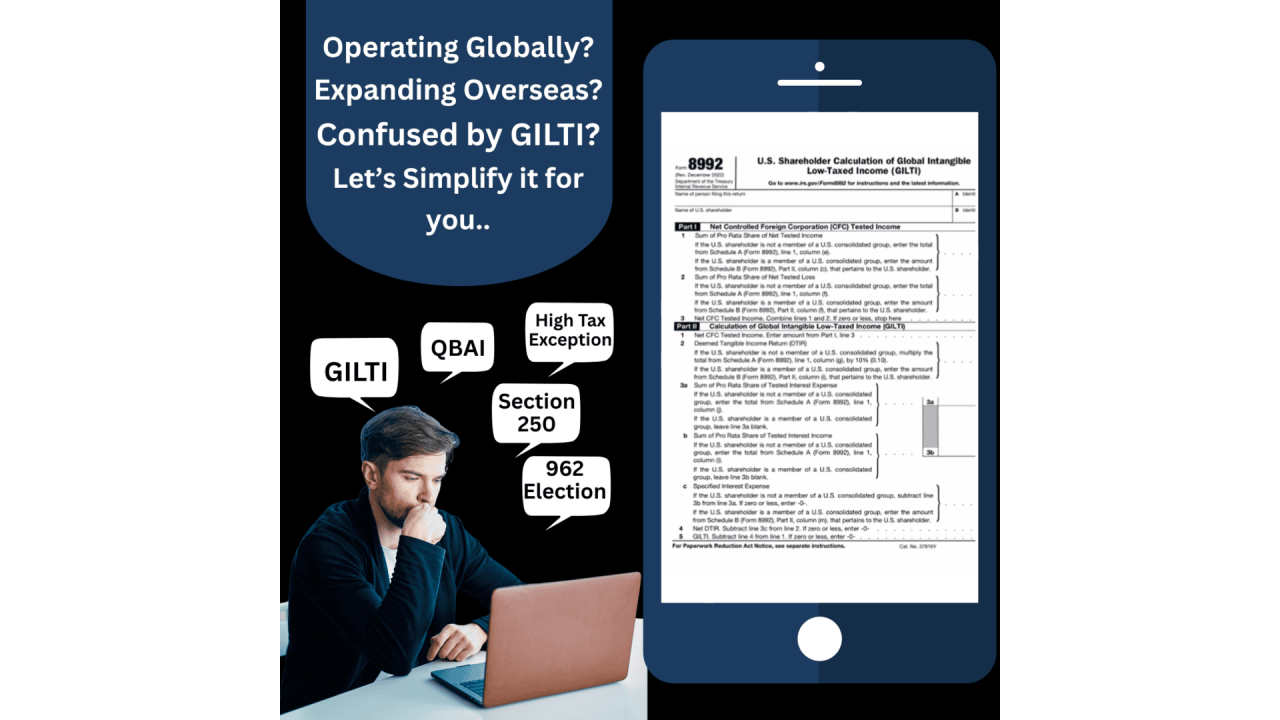
Expanding overseas brings new markets, and a US tax regime that many growing companies only discover at filing time. For years that regime was known as GILTI (global intangible low-taxed income). Under the 2025 federal tax law commonly called the One Big Beautiful Bill Act, it has a new name, net CFC tested income (NCTI), and a different set of numbers for tax years beginning after December 31, 2025.
Here is what the rules cover, what changed, and what US owners of foreign companies should review now.
What the regime targets
GILTI was introduced by the Tax Cuts and Jobs Act of 2017 to discourage shifting profits into low- or no-tax jurisdictions. It applies to US shareholders of a controlled foreign corporation (CFC): a foreign company in which US shareholders who each own at least 10% together own more than 50%.
Those shareholders must include their share of the CFC’s income in US taxable income each year, whether or not any cash is brought home.
What changed for 2026 onwards
- New name. GILTI becomes net CFC tested income (NCTI).
- No more QBAI carve-out. The old exclusion for a deemed 10% return on the CFC’s tangible assets (QBAI) is gone, so capital-heavy foreign operations lose a shelter they used to rely on.
- Smaller deduction. The Section 250 deduction for corporate shareholders drops from 50% to 40%, which lifts the effective rate from 10.5% to 12.6% before foreign tax credits.
- Larger foreign tax credit. Corporations can now credit up to 90% of the foreign taxes tied to this income, up from 80%.
The net effect depends on where the CFC operates and how much foreign tax it already pays. Companies in higher-tax countries may see little change; those with significant tangible assets in lower-tax countries will often pay more.
Individual owners face a tougher picture
Individuals who own CFC shares directly are taxed on this income at ordinary rates of up to 37%, without the corporate deduction or credits. A Section 962 election lets an individual be taxed as if they were a corporation for this income, which can narrow the gap. Whether it helps depends on the numbers and on how future distributions will be taxed, so it is worth modelling before electing.
Compliance still carries real penalties
US owners of CFCs have annual information-reporting obligations, including Form 5471. Missing required international information returns can trigger penalties starting at $10,000 per form, per year, in addition to interest on any unpaid tax.
What to review now
- Re-run your CFC calculations under the NCTI rules, since the QBAI change alone can move the result.
- Model foreign tax credits at the new 90% level, country by country.
- Revisit whether your current entity structure still makes sense for the years ahead.
- For individual owners, test whether a Section 962 election is worthwhile.
How EXP can help
Our tax team prepares US federal and international compliance for US companies with foreign operations, working alongside your in-house team or CPA firm. If your group has foreign subsidiaries and you want a second look at your 2026 position, get in touch.
This article is general information, not tax advice. Rules and guidance continue to evolve; confirm how they apply to your situation before acting.